Fagradalsfjall Volcano Hike With Kids: Ages, Best Tours and What to Expect
Yes, kids as young as two can join a guided Fagradalsfjall volcano tour, though the two hikes that actually climb onto the lava set very different minimum ages, two and twelve, and the age question only gets more complicated from there. I went through every operator's child policy and the real physical demands of each route to write this, because Fagradalsfjall volcano with kids is less a legal question than a readiness one: will a five-year-old's legs and patience survive four to six hours over broken lava, or is a shorter loop the better call. Below: the minimum ages by tour, the honest verdict on the 8 km climb for a young child, which trip fits which age, and the practical things nobody warns you about, starting with the fact that neither car park has a toilet.
Quick answer
Kids from age two can join one of the two guided hikes here, and the other four tours on this site publish no age limit at all. The bigger caveat than age itself: the standard climbing route runs about 8 km with 300 metres of ascent over sharp, uneven lava, which is a genuinely hard afternoon for most children under about eight, whatever the booking system allows.
Key takeaways
- Minimum ages range from 2 to 12 across the site's two climbing hikes; the other four tours publish no age limit
- Age is a floor, not a readiness test: a technically-eligible five-year-old can still have a miserable day on the 8 km climb
- The gas hazard, not gradient, is why the geologist hike sets its line at 12 and names respiratory issues specifically
- Neither car park has a toilet or drinking water, a bigger deal with a young child than with an adult
- No operator on this site publishes a kids' discount
- For a family with a child under about 8, the Reykjanes minibus loop is the tour I'd actually book
Minimum Ages for Fagradalsfjall Tours
The two hikes set the age question; everything else on this site doesn't
Only the two hikes that climb onto the lava itself publish a minimum age. Neither operator states whether it's checked by ID at pickup or simply taken on trust when you book, so treat the number as a hard line regardless. The guided hike comparison covers why those two routes differ on price and guide type; here's the age angle specifically.
| Tour | Minimum age | Why the limit | Best for ages |
|---|---|---|---|
| Small-group hike, local guides | 2 | No reason published; functions more as a formality than a real gate | 8+ realistically, though bookable from 2 |
| Hike with a geologist | 12 | Sulphur dioxide gas exposure, stated by the operator | 12+, teens curious about the science |
| Reykjanes minibus loop | None published | No sustained climb, short stops rather than a hike | Any age able to sit through a 6-hour day |
| Volcano circle | None published | Same reasoning as the minibus loop, longer day | Any age, best with a child who naps in transit |
| Helicopter flight | None published | Seated 40-minute flight, no walking involved | Any age able to sit still and wear a headset |
| Private day | None published | Private guide sets the pace for the group booking it | Any age, since the itinerary can flex around a child |
Where the ages actually cluster
The gap is wide, 2 against 12, and it's real: the geologist hike is the one operator on this peninsula that names a specific health reason for its cutoff. Every other tour here draws no line at all, which tells you the age question at Fagradalsfjall isn't really about legality. It's about whether an 8 km round trip with 300 metres of climbing over broken lava is something your particular child can do, not whether the booking form will let you try.
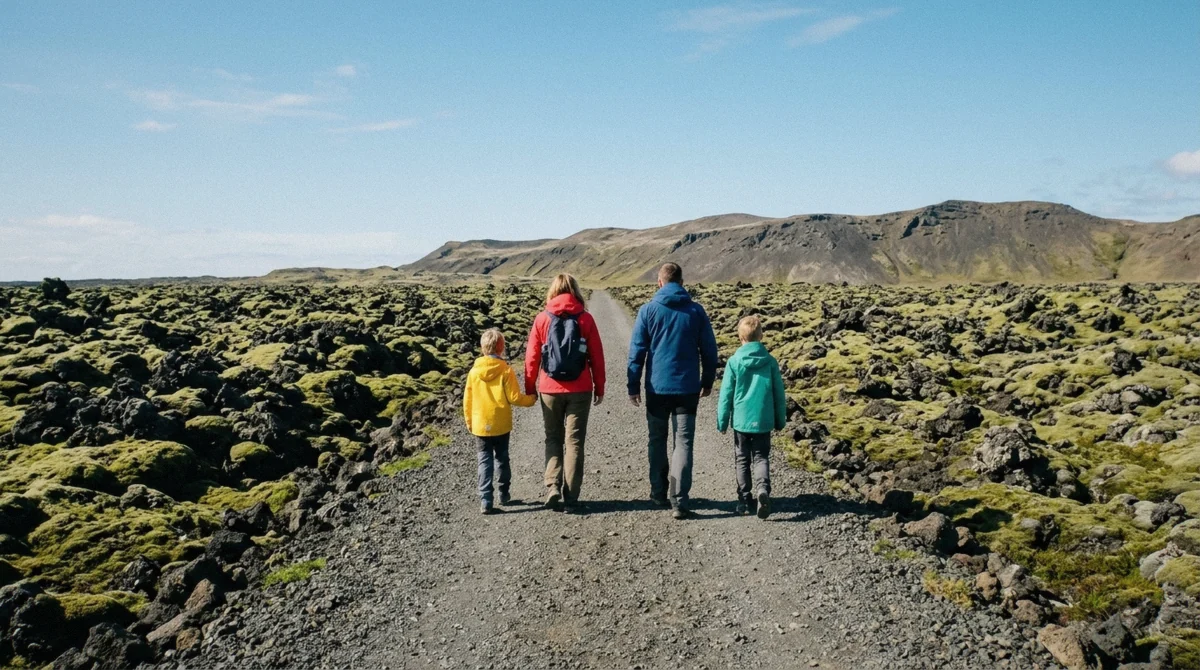
The family-friendly Fagradalsfjall volcano trips split fairly cleanly by how far your children can walk.
Which Trip Fits Which Age
This is the table I'd want as a parent before booking anything. It sets the honest limit at around age 8 for the climbing hikes, not because of the booking system, but because of what the ground actually demands.
| Age band | Which trip works | Why |
|---|---|---|
| Toddler, under 5 | Reykjanes minibus loop or Volcano circle | No published age floor and no required climb; a toddler can nap through most of the drive |
| Young child, 5 to 7 | Minibus loop or Volcano circle, still | The small-group hike admits a 5-year-old on paper, but 8 km and 300 m of ascent over sharp rock is a bad match for most legs and attention spans this age |
| Older child, 8 to 11 | Small-group hike, if your child hikes comfortably at home | This is roughly where the climbing route stops being a fight and starts being an adventure; the minibus loop stays the easier fallback for a less outdoorsy kid |
| Tween or teen, 12+ | Any tour on the site, including the hike with a geologist | The age-12 line clears, and the science-heavy hike becomes a genuine option rather than an exclusion |
The honest read on the 8 km climb
Under about eight, I'd skip the climbing hikes even where the booking system allows it. The route asks for roughly an hour to an hour and a half of ascent each way over ground that shifts from gravel to hollow-sounding lava crust, and the descent, where the surface is wet and slick, is where adults slip. A tired six-year-old on that stretch becomes a child you're carrying, on rock that isn't built for it.
The Reykjanes minibus loop reaches the same eruption sites on stops of a few minutes rather than a multi-hour climb, and that's the trade I'd make with a young child every time.
Which Tour Fits Which Age Bracket
If your child is a toddler or under 5
book the the Grindavík minibus route; no age floor, no climb, several short stops instead of one long one
If your child is 5 to 7 and not a strong hiker
stick with the minibus loop or Volcano circle rather than the climbing hikes, whatever the booking form allows
If your child is 8 to 11 and hikes comfortably at home
the small-group hike becomes realistic; budget the full 4 to 6 hours and expect to carry a jacket, not a child
If your child is 12 or older
the hike with a geologist opens up alongside every other option, including the helicopter flight
If you have both a toddler and a teenager
split the day: one adult takes the older kid on a climbing hike while the other keeps the younger one on the minibus loop or a Reykjavík morning instead
Is It Safe for Kids?
The real hazard here is gas, not the hike itself
Both climbing hikes move at the pace of the slowest walker in the group, which in practice means a guide who has led families before and won't rush a child up the ascent. Neither operator publishes a fixed guide-to-child ratio, and I won't pretend one exists just to sound reassuring.
The actual hazard on this mountain is sulphur dioxide seeping from cooling lava and pooling in hollows when the wind drops, along with a crust that can be hollow underfoot even where it looks solid. The full mechanics, the gas forecast, the closures, the readings guides check every morning, are covered properly on is it safe to visit Fagradalsfjall; I won't re-explain them here. The part worth adding for a parent specifically: gas pools low, in the same hollows a small child is closer to the ground of than an adult standing over them. If a guide calls a route off, that's not caution for its own sake.
Is Your Child Ready? (Not Just the Age Cutoff)
Age gets your child through the door. Readiness decides how the day actually goes
A five-year-old who clears the small-group hike's minimum age can still have a genuinely bad afternoon on this terrain, and a mature seven-year-old doesn't get an exception to the geologist hike's age-12 line either way. Operators enforce the stated number, not your read on your own kid, so don't ask them to make a judgment call at the trailhead.
- Can your child walk several hours over uneven, rocky ground without needing to be carried more than a short stretch? Sharp lava is a hard place to carry a tired child, covered below.
- How does your child handle sustained cold wind and the chance of rain, even in July? A short blustery walk at home is a fair test.
- Will your child stay on a marked path after being told to, even bored or tired an hour in? Some of the crust off the marked route is hollow.
- Is your child calm around new, slightly strange sensory input: a sulphur smell, steam venting from cracks, wind noise on an exposed ridge?
- Match the tour's active walking time, not its total duration, against your child's real attention span. A four-hour hike has maybe ninety minutes of genuinely engaging terrain and a lot of steady walking either side of it.
Best Kid-Friendly Tours
Ordered from easiest on a young child to most demanding.
The Reykjanes minibus loop, for the widest age range
No published age limit, six hours, and the walking is a handful of short stops rather than one long climb, which suits a toddler or a young child who tires fast. It trades the walk onto the flow itself for hot springs, craters seen from short paths, and the Grindavík barrier stop, still a real look at the eruptions without asking much of small legs.
Volcano circle, if you have a full day and a child who naps in the car
The same non-hiking format as the minibus loop, stretched to seven hours with an extra stop. Good for a family that wants more of the peninsula in one day; less good for a young child whose patience runs out before hour five.
The small-group hike, once your child can genuinely hike
Admits children from age 2, but I'd treat 8 as the realistic starting point. What makes it the better of the two climbing hikes for a family: local guides from Grindavík whose own story tends to land with older kids harder than pure geology does, and hiking poles included, which help a shorter child on the descent more than they help an adult.
No Toilets, No Water: Planning the Day Around a Child's Bladder
Neither car park has a toilet, a shop or drinking water, a fact the self-drive guide covers in full for anyone driving themselves. For a family, that's less a footnote than a scheduling problem. Stop in Grindavík or before you leave Reykjavík, because there's genuinely nowhere at the trailhead once you've parked, and a toddler who needs to go twenty minutes into an 8 km hike doesn't have many options beyond the roadside.
On the pickup version of either hike, the Grindavík stop is your last real chance before the climb starts.
Food and Snacks with Kids on the Trail
Nothing is sold at either car park, a fact the what-to-bring guide covers for adults too, but the child-specific problem is timing, not just quantity. Pack snacks to eat at fixed points rather than on demand: at the car before setting off, at the crater viewpoint on the way up, and again as soon as you're back down, since a hungry child on the descent, where the footing gets trickier, is a worse problem than a hungry child on flat ground. A thermos of something warm earns its weight on a cold, wet day, which reviewers say happens even in July.
How Long Can a Kid Actually Stay Engaged?
Attention span, not the tour's stated length, is what actually limits a young child's tolerance for this hike.
| Age band | Realistic focused-attention window | What that means on a 4 to 6 hour hike | Signs it's time for a break |
|---|---|---|---|
| Toddler, 2 to 4 | 10 to 20 minutes of active interest at a stretch | The drive and the climb both run far longer than this; better suited to the minibus loop's short stops than the full hike | Going quiet, reaching to be carried, refusing to keep walking |
| Young child, 5 to 7 | 20 to 40 minutes | The climb up alone can take an hour to ninety minutes; expect at least one stretch that drags | Asking how much further, fidgeting with a jacket or pack, slowing down without saying why |
| Older child, 8 to 11 | 40 to 60 minutes | Close to matching the active segments of the hike, with the crater viewpoint as a natural reset | Going ahead too fast then flagging, complaining about specific discomforts like wet socks |
| Tween or teen, 12+ | An hour or more | Generally matches the hike's real demands, including the geologist hike's content-heavy pacing | Disengaging from the guide's explanations, checking a phone if there's signal |
None of that means a young child can't enjoy any part of the day. The moments that reliably grab attention regardless of age are the ones with something to touch or feel: warmth through a crack in the crust, steam rising off the ground, the sharp line where moss starts and stops. The moments that drag are the steady uphill stretches with nothing new to look at, and there's no way around admitting that plainly.
What the Hike Actually Feels Like for a Kid
The parts that land, and the parts that drag
The pickup and roughly fifty-minute drive out of Reykjavík is dead time for most kids past the novelty of the first ten minutes; a tablet or a window seat buys you more patience than a guide's commentary will at that age. The Grindavík stop, on the pickup version of the small-group hike, tends to land better with an older child who can follow the story of a town people had to leave than with a toddler who just sees empty houses.
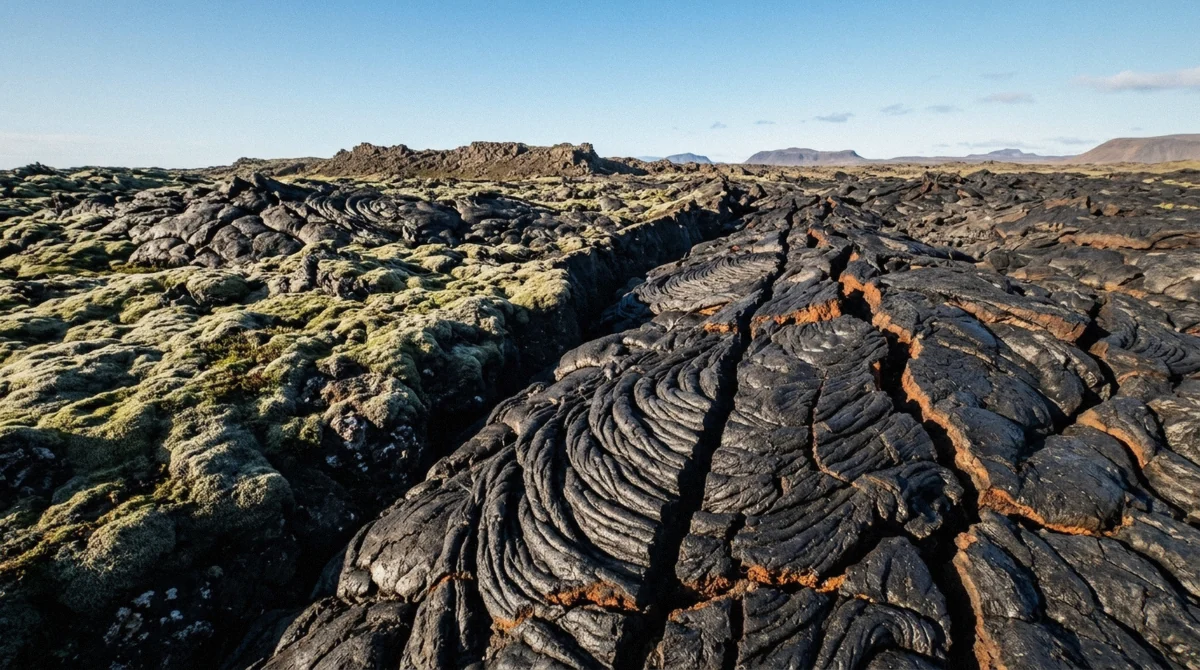
The climb itself is the honest hard part: roughly an hour to an hour and a half of uphill walking on ground that shifts from gravel to uneven, sharp-edged rock, and a young child's pace on that surface is genuinely slower than an adult's estimate of it. The payoff at the crater viewpoint is real and reliably lands with kids of any age old enough to walk it: steam still rising from cracks in the crust, warmth you can feel through the rock, and a visible line where grey-green moss stops and bare 2023 lava begins. That's the moment worth pointing a child's attention at directly.
The descent is where the day gets hard again, for adults and kids both. Wet rock is slick, legs are tired, and this is the stretch where a child who was fine on the way up starts asking to be carried.
Carrying a Child on the Lava, and Keeping Them on the Path
This is the part of a family hike here that generic packing advice never covers. The lava crust is sharp enough to cut an unprotected hand as easily as a foot, so a child who trips and puts a hand out to catch themselves is at real risk of a cut, worth mentioning to an older child directly before you set off. Carrying a tired younger child across that same surface is genuinely awkward: the ground is uneven enough that a carrier or a piggyback changes your own footing and balance, not just your load, so plan on this being a two-adult job if you're bringing a child who might need it.
Staying on the marked path matters more here than it would on an ordinary hiking trail. Off the trail, the crust can be hollow, meaning it can sound solid and still give way, and a child who wanders a few steps to look at something interesting is exactly the person that rule is written for. Keep a young child's hand held or within arm's reach on any stretch where the path narrows or the ground looks broken, and don't treat the marked route as a suggestion just because the lava on either side of it looks the same.
What to Pack for Kids, and What Doesn't Work Here
Mostly the adult list, sized down
Neither guided hike publishes child-sized gear, so a child's boots, waterproofs and layers are entirely on you; the full packing list covers the adult version and applies directly, just smaller. Two things worth adding specifically for a child: pack a spare pair of gloves, since small hands get cold and wet faster than an adult's do, and if you're self-driving, know that the winding stretch of Route 42 and Route 427 has caught out a few kids prone to car sickness on other Icelandic day trips, so plan a front-seat view or a window seat if that's a known issue for yours.
- Boots with ankle support, sized for your child, broken in before the trip
- A spare pair of gloves, small hands lose heat fast
- A hat with a chin strap, better than a loose one on an exposed ridge
- Sun cream and sunglasses sized for a child; the glare off black rock is real even under cloud
- Snacks packed for fixed stops, not eaten on demand
- A carrier for the non-hiking tours only, never for the climbing routes
Strollers and baby carriers
Leave the stroller in the car. The packing guide already covers why: the lava surface makes a stroller unusable past the parking lot on any of the climbing routes. A soft carrier works for an infant on the non-hiking tours, the minibus loop or the volcano circle, where the walking is short and flat, but isn't something either operator publishes support for on the climbing hikes, and I wouldn't attempt the 8 km route with a carried infant myself.
Best Time of Year to Bring Kids
June through early September gives a family the most forgiving version of this trip: snow-free ground underfoot and the longest daylight window if a child's pace runs slower than the guide expected. It's also the busiest and most expensive season, and midsummer here still turns wet and windy without warning, so pack your children for cold regardless of the calendar. Winter adds ice on the descent and a shorter daylight window, both harder with a child in tow.
The full month-by-month breakdown lives on picking a month that suits children.
Not Old Enough for the Geologist Hike? What Still Works
A child under 12 can't book the geologist-led hike, but that still leaves the small-group hike from age 2, and the minibus loop, volcano circle, helicopter flight and private day, none of which publish any age floor at all. There's no waiting area at the trailhead for a parent to sit out the climb with a too-young sibling, so if your group spans a toddler and a hiking-ready older child, the practical fix is picking a tour that fits the youngest, not splitting the group at the car park.
Fagradalsfjall With Kids: Common Questions
What is the minimum age for the Fagradalsfjall hikes?
Two on the small-group hike with local guides, twelve on the hike with a geologist, because of gas exposure. The other four tours on this site, the minibus loop, volcano circle, helicopter flight and private day, publish no minimum age at all.
Can a 5-year-old hike Fagradalsfjall?
The small-group hike's booking system would let you, since its minimum is 2, but I wouldn't recommend it. The route runs about 8 km with 300 metres of climbing over sharp, uneven lava, genuinely hard for most five-year-olds, and the Reykjanes minibus loop reaches the same eruption sites without the climb.
Is the volcano hike scary for kids?
Not typically. The moments most likely to startle a child, steam venting from a crack or the smell of sulphur on the wind, are usually explained by the guide before a child reacts to them. The bigger risk to a good day isn't fear, it's fatigue on the descent.
Do kids get a discount on a Fagradalsfjall tour?
No operator on this site publishes a kids' price. Every ticket, adult or child, books at the same rate shown at checkout.
Will my kid get bored on the hike?
Somewhere in the middle of it, probably. The crater viewpoint and the steam and warmth coming off the crust genuinely grab a child's attention; the steady uphill stretches on either side of it don't, and there's no honest way to promise otherwise.
What if my child gets cold, tired or scared partway through?
Both climbing hikes run as a fixed group at a shared pace, and neither operator publishes an early-return option once you're on the trail. If that risk worries you, the Reykjanes minibus loop, with its short stops instead of a sustained climb, removes the problem before it starts.
Can toddlers do a Fagradalsfjall volcano tour?
Not the climbing hikes in any practical sense, even though the small-group hike's stated minimum is 2. The minibus loop and volcano circle are the realistic options for a toddler, since neither asks for sustained walking and neither publishes an age floor.
The age question at Fagradalsfjall has a real answer, two and twelve on the two hikes, but the more useful question is whether your particular child's legs and patience match what an 8 km climb over broken lava actually asks. Under about eight, I'd take the minibus loop every time and save the climbing hike for a trip when the kids are older. For the full spread of family-friendly Fagradalsfjall volcano trips, matched to whichever age band you're travelling with, that's what to book next.