Hike Fagradalsfjall Without a Tour: Can You Do It on Your Own?
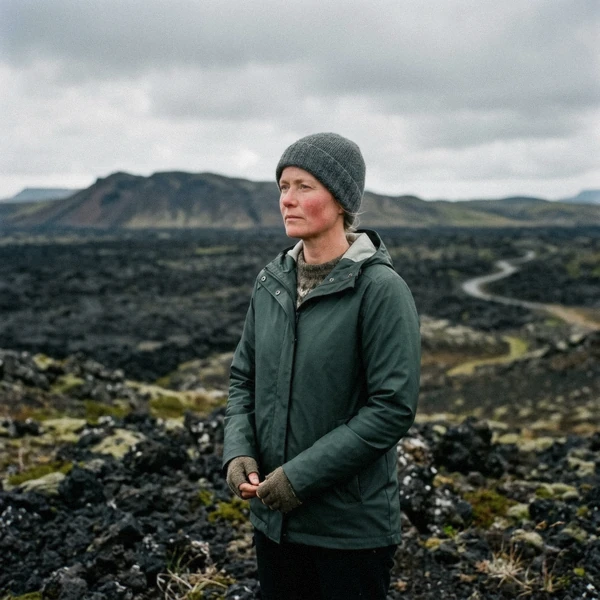
Yes, you can hike Fagradalsfjall without a tour. The trails are public, open every day of the year, and nobody checks a permit at either car park. I've watched people who had never seen a lava field before manage Trail A on their own, and I've also watched a couple turn back cold and soaked twenty minutes in because they packed like it was a city walk. The real question isn't whether it's legal. It's whether you have the gear, the driving nerve for Icelandic gravel roads, and the patience to read a gas forecast before you leave the car.
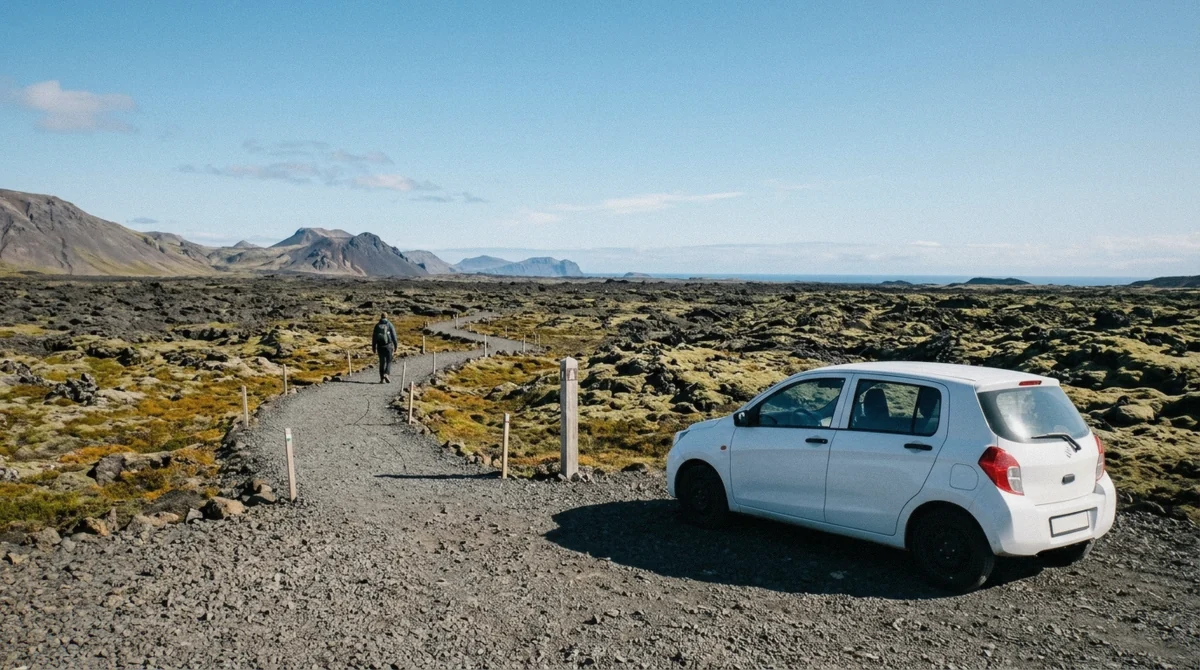
Quick answer
You can hike Fagradalsfjall entirely on your own. The trails are open public land with no permit or guide requirement, and a group of three or four sharing a rental car will usually beat the price of a guided hike. What you give up is the geologist or Grindavík local reading the ground, the gas readings and the weather for you.
Key takeaways
- Verdict: fully DIY-viable. No permit, license or guide mandate applies to any of the five marked trails.
- Solo self-drive in August costs about $157, roughly what the geologist-led hike charges; split among four it drops near $39 a head.
- A tour adds something DIY genuinely can't: a guide who reads the sulphur dioxide forecast and the ground in real time and calls off a route before it gets risky.
- Biggest safety caveat: check the Icelandic Meteorological Office gas forecast and safetravel.is before you leave, every time, tour or not.
- DIY suits confident drivers and groups of three or more; first-timers without a rental car do better on a guided hike.
- No scheduled bus reaches either car park, so "without a tour" still means arranging your own transport.
The Short Answer: Do You Need a Tour?
No permit, no license, no gate
Fagradalsfjall sits on open land inside the Reykjanes UNESCO Global Geopark, and Iceland's right-to-roam tradition means nobody needs to buy their way onto the trail. The eruption site area stays open 24 hours a day, the car parks have no barrier arm, and the only payment anywhere in the system is a 1,000 ISK parking fee, paid on trust through an app.
That's the governing fact behind everything else on this page. If you can drive to the car park and read a map, you can walk the same ground the guided volcano tours that include the transport walk, minus the person explaining it.
Where the calculation gets harder is logistics, not law. No bus serves the trailhead, winter driving on Route 427 is a different skill than summer driving, and gas from cooling lava is a real, manageable hazard that a guide is trained to watch for.
DIY vs Tour at a Glance
What each route actually costs and gives up
Neither side of this table is padded. A self-driver reaches the same lava a guided hiker does; a guide adds judgment, not access.
| On your own | With a tour | |
|---|---|---|
| Cost per person | About $157 solo in August, near $39 in a group of four (car hire + fuel + tax + parking) | $112.54 to $157.55, transport included |
| What you can reach | Every marked trail: A, B, C, E and Nátthagi, no permit needed | The same trails, plus the Grindavík barriers worked into the minibus route |
| Gear | Bring your own boots, layers and crampons; nothing rents at either car park | Poles or crampons lent on both guided hikes when the season needs them |
| Safety & backup | You read the gas forecast and the weather and decide alone | A guide reads the same forecasts and has turned a group back before |
| Time & flexibility | Your own pace, but you drive both ways yourself | Fixed group pace, pickup and drop-off handled for you |
| Best for | Confident drivers, groups of three or more, budget-first trips | First-timers, solo travellers, anyone without a rental car |
Where the table actually settles it
Solo travellers pay about the same either way, so the DIY case gets weaker the smaller your group is. Once three or four of you split a rental car, the math flips hard enough that only the gas forecast and your own confidence behind the wheel should decide it.
Car Parks and Trailheads
The two paid car parks, the trails leaving from each, and the towns either side of the route. Plan your own turnaround time from this; nothing here needs an app to load beyond your browser.
Where You Can Do It on Your Own
Five marked trails leave the two car parks, and each one asks something different of you.
Trail A, the standard route (pink)
This is the path almost everyone means when they say they hiked Fagradalsfjall. It leaves from P1 Geldingadalir, runs 6 to 8 km one way depending on exactly where you park, and takes 2 to 2.5 hours each way over ground that goes from gravel to hardened lava crust as you climb. It reaches the 2021 and 2022 eruption sites, the same ground every guided hike on this site walks.
Pay for parking through the Parka app before you set off, or within 24 hours after, since there's no barrier and no attendant at either lot. Card and app both work; cash doesn't, because nobody's standing there to take it. Roadside parking along Route 427 isn't allowed, so it's P1 or nothing.
The surface decides your day more than the distance does. Loose scree near the top and ropey, hollow-sounding lava lower down both slow you compared to a paved trail of the same length.
Nátthagi, the short version (yellow)
If you want cooled lava under your boots without committing an afternoon, this is it. It runs about 2 km one way from the same P1 car park and reaches the lava front in under an hour, flat enough that a family with a tired eight-year-old can still enjoy it.
Same parking rule applies: 1,000 ISK for 24 hours, paid through the app, no cash option on site. Conditions are the gentlest of the five routes, though the lava itself is still sharp enough to want real boots rather than trainers.
Langihryggur ridge, for the view (green)
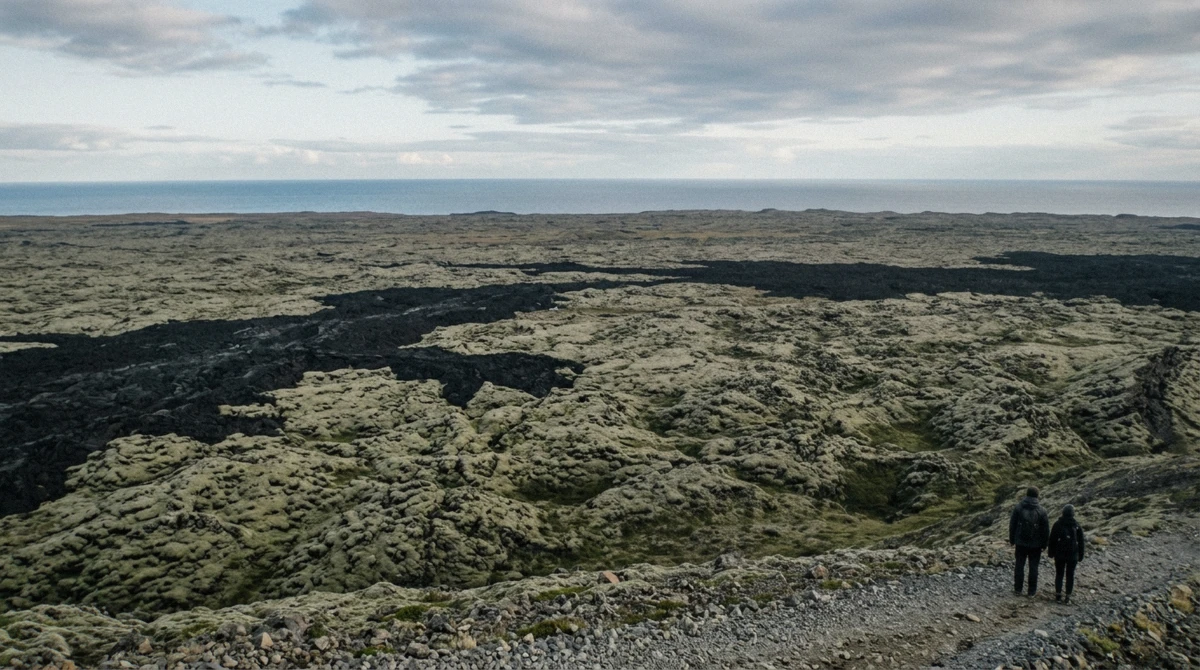
Trail C climbs about 4 km one way from P2 Stóri-Leirdalur, roughly 1.5 to 2 hours of walking, and delivers the one viewpoint on the whole peninsula that shows the 2021, 2022 and 2023 lava fields in a single frame. If you only have time for one hike and want the photograph that explains five years of eruptions at once, this is the route, and it costs nothing beyond the same parking fee.
P2 gets less traffic than P1, which on a July weekend is its own reason to choose it.
The two long days: Trail B and Trail E
Trail B, dark blue, runs from either car park toward the Sundhnúkur lava, with a first viewpoint at 4.7 km and a second at 6.1 km, about 2 hours to the first stop. Trail E goes further still, 18 to 20 km round trip to Meradalir and Litli-Hrútur, 5 to 6 hours of walking on exposed ground with no guide, no checkpoint and no way to shorten it once you commit.
Both are genuinely self-guided options, not just theoretically legal ones, but Trail E in particular wants an early start, a full water supply and a weather window you trust for the whole day. Nobody rescues you faster because you meant to hike it alone.
What DIY Really Costs
The real math, not the general claim
Line items first. Parking is 1,000 ISK, about $8, per car for 24 hours, split however many people ride along. Round-trip fuel from Reykjavík runs roughly 100 km, about 7 litres at current prices, close to $12. Add the per-day road tax most rental companies now bill as a flat charge rather than a metered one, roughly $11 to $12. Car hire itself swings hardest by season, from about $45 a day in winter to $125 or more in August.
Put a solo August traveller through that math and the total lands close to $157, within pennies of what the geologist-led hike charges for a full guided day. The case for DIY gets stronger fast once you're not travelling alone: split the same rental car four ways and the per-person total drops to around $39, against $148.72 to $157.55 each on a guided hike. Three or four people going together is where "DIY is cheaper" stops being a hopeful claim and starts being arithmetic.
Last verified: July 2026, using an exchange rate of roughly 1 USD to 125.5 ISK.
| Party size | Car hire (August) | Fuel + tax + parking | Total | Per person |
|---|---|---|---|---|
| Solo | $125 | $32 | $157 | $157 |
| Two people | $125 | $32 | $157 | $79 |
| Group of four | $125 | $32 | $157 | $39 |
How that compares to the guided side
For what each guided option actually charges and includes, see what each guided option actually costs. The short version is that solo DIY buys you almost nothing over a guided hike; a group of three or more is where the savings become real.
Which Option Fits You?
If you have a rental car already and calm weather in the forecast
hike Trail A or Nátthagi on your own; both are well marked and cost nothing beyond parking
If you're travelling solo without a car
book a guided hike; the price gap to a rental-plus-fuel solo trip is small, and you get the transport and the explanation with it
If there are three or more of you with a car
go DIY; the per-person cost drops well below any guided option
If you want the Grindavík story and the barriers, not just the lava
book the small-group hike or a minibus loop, since the hiking trails alone don't pass through town
If you're unsure about reading a gas forecast yourself
let a guide make that call; both operators check it every morning before departure
When Skipping the Tour Is the Right Call
Where DIY genuinely wins
Skip the tour without hesitation if you already drive comfortably on Icelandic gravel and rain, you're travelling in a group of three or more, and you're sticking to Trail A, Nátthagi or Langihryggur, the three best-marked routes. None of that is a hedge. People do this every week and come back happy, and I've met more than a few who preferred figuring out the moss line themselves rather than having it pointed out.
Budget travellers land here too. If the choice is between a $157 hike ticket and a $39 share of a rental car, and the geology lecture isn't the draw, the money argument alone settles it.
When a Tour Is Genuinely Worth It
Where a guide earns the fee
Book a guide if you're solo without a rental car, if this is your first time reading Icelandic weather, or if you want the geology and eruption history explained rather than looked up afterward. The geologist-led hike puts a working volcanologist in front of you, which no trail sign replicates. The small-group hike does the same with guides from Grindavík who watched their own town evacuate, and that context changes how the barriers along the road read.
A guide's real value on this mountain is judgment under changing conditions, not access to different ground. Both operators check the gas forecast every morning and have turned groups back before conditions got risky, a call that's harder to make alone the first time you're standing in front of it. If you'd rather skip the climb entirely and still see cooled lava, the a guided van tour instead reaches the lava edge and Grindavík on short, easy walks.
Safety Rules Either Way, Tour or Not
The gas forecast is not optional
The lava isn't the danger here; the air over it can be. Sulphur dioxide seeps out of cooling rock and pools in hollows when the wind drops, which is why every guide on the peninsula checks the same two sources before leaving Reykjavík: the gas forecast on en.vedur.is and the road and hazard status on safetravel.is. Do the same if you're going alone. If you catch a sulphur smell on the trail or your chest tightens, turn around and walk upwind; don't wait to see if it passes.
Stay off the lava itself, not just the obviously broken parts. A crust that looks solid can be hollow, and rock under a young flow can still sit close to 1,200 degrees Celsius. Trails close at short notice when readings climb or the ground starts moving again, and a self-driver finds that out at the car park sign rather than from an operator's cancellation email, so build a backup plan for the day into your itinerary. For the complete list of what to pack, including winter spikes, see what to actually pack for this hike.
- Check the gas forecast on en.vedur.is the morning you go
- Check safetravel.is for road and trail closures
- Pay parking through the Parka app before or within 24 hours of leaving
- Tell someone your route and expected return time
- Pack water and food; nothing is sold at either car park
- Carry proper boots and full waterproofs regardless of the forecast
- Add spikes or micro-crampons November through April
- Turn around at the first sulphur smell or tightness in your chest
- Bring a charged phone with offline maps saved
Can You Get There Without Renting a Car?
Not practically, no
Be honest with yourself here before you book flights around a car-free plan: no scheduled bus serves either car park, and there's no public shuttle. If you don't want to drive, your realistic options are a taxi you've arranged to collect you again, since there's no rank waiting at the trailhead, or a guided hike with hotel pickup in Reykjavík, which solves the transport problem outright. A minibus loop such as the Reykjanes minibus tour does the same if you'd rather skip the climb and still stand on cooled lava.
One hybrid exists worth knowing about: at least one operator lets you drive to a meeting point in your own car and follow the guide's vehicle from there, which some travellers use specifically to avoid navigating the last stretch of gravel alone. It still needs a car, just not one you drive the whole way solo.
A Simple DIY Morning Plan
With a rental car
Leave Reykjavík by 8:00 to be parked and walking before the day's tour buses arrive. Pay the Parka fee from the car park before you lock up. Take Trail A to the crater viewpoint, budgeting 2 to 2.5 hours up and the same back down, and eat lunch at the top rather than the car, since there's nowhere to buy anything at either end.
If the weather holds and you still have energy, the short Nátthagi path from the same lot adds under an hour and a different angle on the same flow. Back in Reykjavík by early afternoon, with the rest of the day free for the city or the Blue Lagoon on the way.
DIY Fagradalsfjall Questions
Can you hike Fagradalsfjall without a tour?
Yes. The trails are public land inside the Reykjanes UNESCO Global Geopark, open around the clock, with no permit or guide requirement at either car park. What you're really deciding is cost and confidence, not legality: a solo self-drive costs close to a guided hike, while a group of three or more usually comes out ahead.
Is it cheaper to hike Fagradalsfjall yourself?
It depends entirely on group size. Solo, a self-drive in August runs about $157 once car hire, fuel, road tax and parking are added up, essentially the same as the geologist-led hike. Split among four people, the same trip drops to roughly $39 each, well under any guided price on this site.
Is it safe to hike Fagradalsfjall without a guide?
Yes, if you check the same two sources a guide would: the gas forecast on en.vedur.is and the hazard status on safetravel.is, both the morning you go. Stay off the lava itself, since a young crust can be hollow and the rock beneath it can still run close to 1,200 degrees Celsius, and turn back at the first smell of sulphur.
Can I reach the same spots without a tour?
Yes, all five marked trails are open to anyone. The one thing self-drivers usually skip is the Grindavík stop with the earth barriers, since that sits on the minibus route rather than the hiking trails, not because it's restricted, just because it's a driving detour most hikers don't add on foot.
What's the parking fee at Fagradalsfjall, and how do I pay it?
1,000 ISK, about $8, covers 24 hours at either car park. Pay through the Parka app or at parka.is; there's no barrier, no attendant and no cash option, and you have up to 24 hours after leaving to settle it if you had no signal on site.
Can beginners hike Fagradalsfjall alone?
If you're reasonably fit, comfortable on uneven ground and driving yourself, yes, especially on Trail A or Nátthagi. If you're a first-time hiker without a rental car or unsure about reading Icelandic weather, a guided hike removes both problems at once.